This morning, at 10:00 a.m. Central, BMO business customers opened their digital banking portal and found something new: the ability to send protected international payments to more than 200 countries, all without a branch visit, a wire form, or a leap of faith.
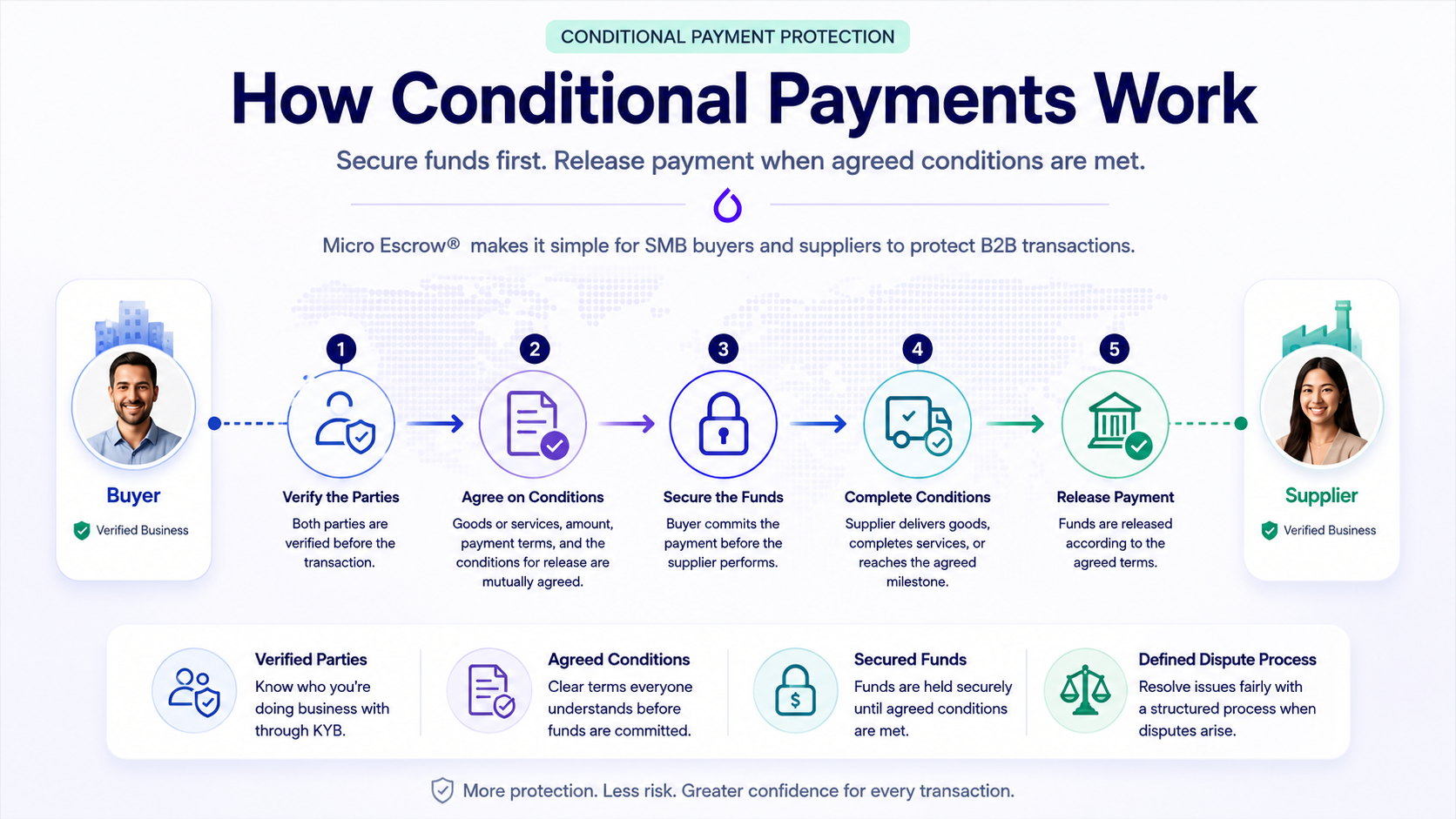
Simple Pay is designed for the suppliers, contractors, and partners they already know. Protected Pay, powered by our patent-pending Micro Escrow®, is for the ones they don't. It holds the funds until both sides agree that the goods arrived or the work was delivered.
After three years, it is finally live - with a real bank, serving real clients, and moving real money.
This isn't the official launch announcement. That will come soon from BMO and LiquidTrust™, and we look forward to celebrating it then. But for now, I want to take a beat to share how long this took and to recognize the people who helped get us here.
What Launch Day Actually Looks Like
Let me tell you what launch day actually looks like because this part rarely makes it into founder stories.
Launch day isn't really champagne. It's a new menu item appearing in a bank portal. It's checking whether a carousel rendered correctly, confirming that the random null value in column 11 of a nightly ledger file was properly fixed. It's making sure the SSO session that behaved differently on Android last Tuesday is now behaving as it should.
Basically, it's clicking around a bunch of places to make sure everything still works, even though you've already checked those same places hundreds of times over the past three weeks.
Sometimes it's someone on the team writing in Slack, "It's literally live." Everyone stares at the message for a moment, and then we go back to work.
The distance between signing an agreement and seeing a real business send a protected payment is measured in hundreds of unglamorous decisions: risk requirements, compliance reviews, pen tests, trademark disclosures, fraud-monitoring architecture, file formats, data fields, and a launch date that moved more than once.
Nobody writes a press release about column 11. But that is the actual work of putting a startup's technology inside a 200-year-old bank, and I have enormous respect for everyone on both sides who did it.
Getting here took almost three years, a difficult reinvention, and one conversation in a conference hallway.
The Trust Gap
As I shared last year in "From Setback to Reinvention: How LiquidTrust Was Born", the path to this launch began during a difficult period for our first company, Liquid.
We were losing customers – not because they were unhappy with our product – but because their businesses were shutting down. That downturn exposed something I couldn't unsee: in most transactions, the smaller business carries the risk.
Large enterprises have access to letters of credit and other protections. Everyone else is often expected to accept the risk as a "cost of doing business." They send the money and hope the goods or services show up. Or they deliver the work and hope they get paid.
We came to call this "the trust gap," the space between what a transaction requires you to believe about someone and what you can actually verify. The gap is especially wide across borders, where pursuing a missing shipment, unpaid invoice, or dispute may be impractical for a small business.
Escrow can close the trust gap, but it has historically been only associated with houses, acquisitions, lawyers, and weeks of paperwork. We believed the same basic protection, holding the money until both parties agree that the terms were met, should be simple and affordable enough to sit inside an ordinary business payment.
So we built Micro Escrow® for goods and services, domestically and across borders. And yes, we trademarked it. When you spend three years explaining a category that doesn't exist yet, you eventually own the words.
The Chair Outside the Hall
But I couldn't shake one problem: small businesses weren't going to come find us. We needed to meet them where they already moved money.
Three years ago, I arrived at Fintech Meetup with that idea but no distribution. I struck up a conversation with Andrew Harrison, who ran partnerships at BMO. When I described what we were building, his first reaction was, "I can't believe this doesn't already exist."
Andrew told me about WMNfintech, the accelerator BMO runs with 1871 for women fintech founders. I applied that same day from a chair outside the conference hall, not knowing that the application would set us on the path to today.
WMNfintech is where the idea began to become a business. BMO's mentors helped us pressure-test the product against how a bank actually operates: compliance, risk, technology, and distribution. It is also where I met Anthemis and Motivate, which would later invest in LiquidTrust.
By the end of the program, we knew this was the direction we needed to pursue. Getting there meant shutting down a working product with paying customers and becoming a different company. We chose a recapitalization rather than a clean break so we could honor the people who had backed Liquid and bring them with us as we built LiquidTrust.
Thank You
First, thank you to our team. You stayed focused through every change, setback, late-night question, unexpected requirement, and revised timeline. You kept moving forward even when the finish line moved. I'm incredibly grateful to be building this with you.
Thank you to BMO and to Andrew, whose hallway conversation changed the trajectory of our company. Thank you to Monica Genz, Jerry Breef, and the countless people across BMO's product, technology, risk, compliance, legal, implementation, and marketing teams who spent the past two years turning a partnership into something customers can actually use.
Banks sometimes get a reputation for moving slowly. What I experienced was a bank moving carefully. That is different, and it is exactly what you want from an institution entrusted with its customers' money.
Thank you to our investors. Mike Hirshland at Resolute, one of the most insightful and supportive investors I know, gave me the permission I needed to make the pivot. Thank you to Anthemis Female Innovators Lab and Motivate for backing our second act and to our original Liquid investors who chose to stay with us.
This Is a Starting Line
We are the first WMNfintech company to launch commercially with BMO, and BMO is the first bank to put LiquidTrust in front of its business clients. I'm incredibly proud of both of those firsts.
But a first customer is not a market. Tomorrow, we go back to work: more banks, more platforms, domestic payments, services as readily as goods, and eventually the letter of credit itself.
Escrow has spent a century largely reserved for houses and acquisitions. We believe it belongs in every business transaction where one party has to take the risk of going first.
The trust gap isn't only a small-business problem. It is the tax the global economy charges anyone who isn't large enough to hire their way around risk. "Pay and pray" isn't a strategy. It's simply what's left when nobody has built you anything better.
Today, we proved that something better can live inside a bank.
Thank you for being part of it. Let's go. 🚀