Relationship managers are getting a question they cannot answer. A customer has a deal with a supplier they have not dealt with before. The amount is large enough to hurt if it goes wrong, and they want to know whether the bank can offer any form of payment protection for business customers on a transaction like this. The need is particularly acute when the funds are being sent cross-border.
The honest answer, at most institutions today, is no. Not because the need is unreasonable, but because none of the products a bank already sells is shaped for it.
The rest of this article is the case for doing something about it. If you would rather skip the diagnosis, here is how a bank can offer protected payments to its business customers today.
What business customers are actually asking for
The customer is about to send money overseas to someone who has not yet done anything. Once the wire leaves, the money is gone and so is the leverage. If the goods/services never ship, or arrive wrong, the customer is reduced to asking a stranger in another country to send the money back or fix the problem some other way. They know how that usually goes.
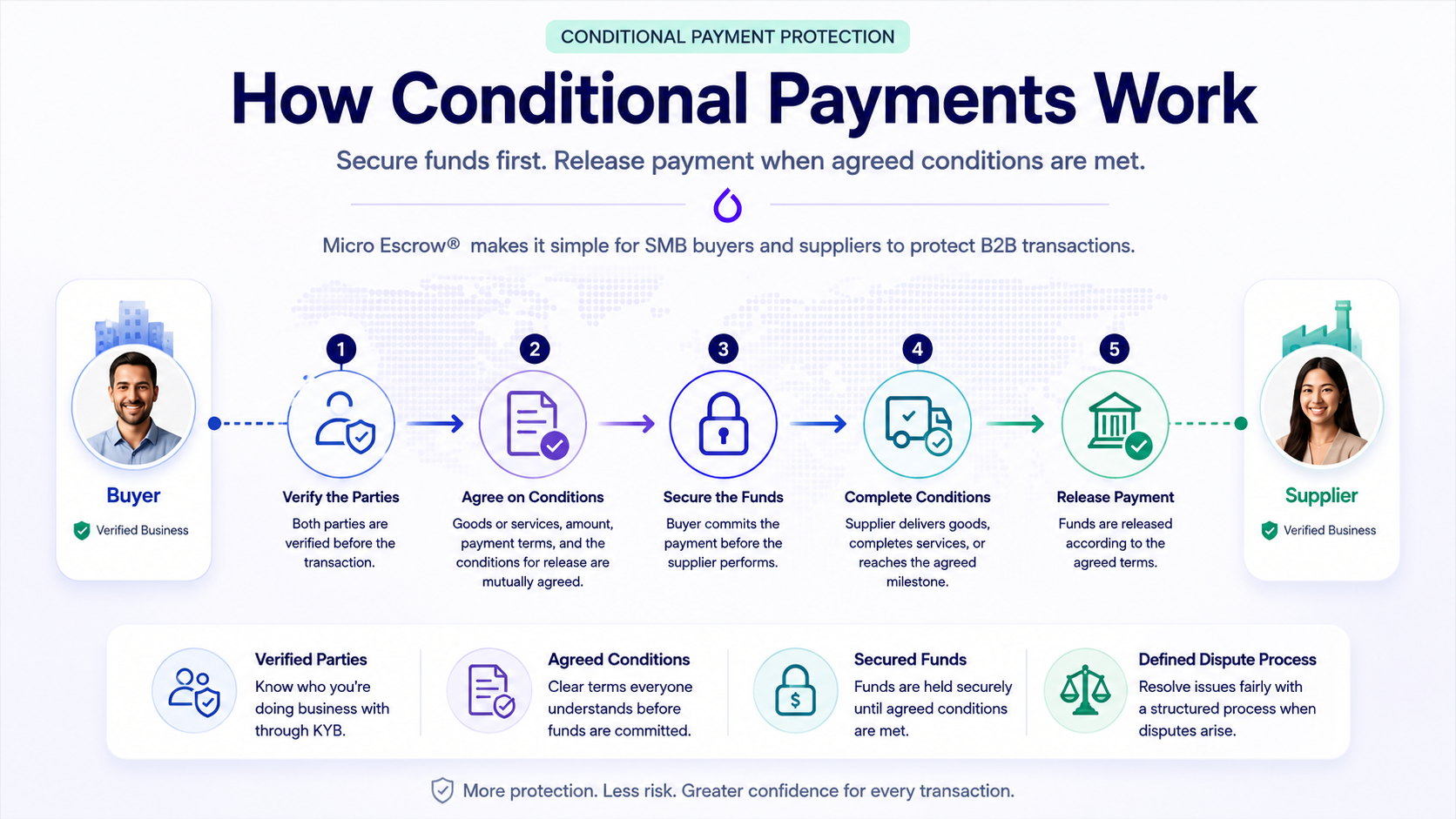
They rarely use the word escrow, and almost never use the word conditionality. What they would agree to, if someone told them it was on offer, is this. Commit the money now. Let the supplier see that it is committed. Keep it from leaving until the supplier does what they said they would do. Most customers never ask for that, because they do not know a bank can do it.
That is a request for a conditional payment. The funds are real and visible, which gives the supplier enough confidence to start work or ship goods. The release is tied to something happening, which gives the buyer enough confidence to commit. Both sides get what they need from the same instrument. We have written separately about what this looks like in practice, in Conditional Payments and Micro Escrow®: A Practical Way to Protect B2B Transactions and in What “Secure B2B Payment Solutions” Really Mean for Marketplaces.
The pattern to listen for
When a customer asks whether a wire can be reversed, or how quickly the bank can recall one, they are not asking about operations. They are telling you they do not trust the counterparty and they have no better tool available.
Why the question reaches the bank now
Two things changed at once. Finding a counterparty on the other side of the world became easy. Verifying one did not. A business that would once have traded within a known network now sources from suppliers it found online, in jurisdictions where it has no way to assess who it is dealing with.
At the same time, payment speed improved everywhere. Faster settlement is a genuine benefit between parties who trust each other. Between parties who do not, speed narrows the window in which anything can be checked, questioned, or stopped. The customer feels this even if they cannot articulate it, and they take the question to the institution they already trust.
The gap in the current product set
| Instrument | What it does well | Why it does not fit this request |
|---|---|---|
| Wire transfer | Fast, familiar, works at almost any value | Settles as an unconditional transfer. Once sent, recovery generally depends on the recipient's cooperation |
| Commercial card | Some recourse through scheme rules | Acceptance, transaction limits, and interchange rarely suit B2B values or terms |
| Letter of credit | Strong protection on documented trade | Documentation, cost, and timeline often exceed what a mid-sized deal can absorb |
| Open account terms | Simple, cheap, preserves the relationship | Places the entire risk on one party, which is exactly what the customer is trying to avoid |
This is not a gap in sophistication. It is a gap in shape. Every instrument above is either unconditional or heavyweight. The customer is asking for something conditional and light.
What happens when the bank has no answer
The transaction does not stop. The customer finds another route. Sometimes that is a third-party platform that holds funds and releases them on agreement. Just as often it is defaulting to whatever the counterparty already uses, which is rarely the customer's own bank. Either way the deal completes and the bank is not part of it.
- The balance moves out ahead of the transaction and may not come back
- The bank loses visibility into a material commercial event in the customer's business
- Any fee on the protected leg of the transaction accrues elsewhere
- The customer learns that a category of financial need is solved somewhere other than their bank
The last point is the one that compounds. Business banking relationships erode through small absences rather than single failures.
What payment protection looks like inside a business banking offer
In practice it has four parts, and a bank can recognize each of them from instruments it already understands.
- Verification of the counterparty before funds are committed, so the customer knows who is on the other side
- Funds held against the transaction, visible to both parties, and out of the reach of either one unilaterally
- Release conditions agreed in advance, tied to something observable such as delivery, inspection, or a completed milestone
- A record of what was agreed and what happened, so that if the parties disagree there is something to point at
None of this is novel in concept. It is escrow, applied at a transaction size and speed that traditional escrow arrangements were never built to serve. What has changed is that it can now sit inside a digital flow, rather than in a separate arrangement stood up deal by deal, such as a client account at a law firm.
The questions to work through before deciding
A bank has three routes: build it, partner with a provider, or refer customers out and accept that the transaction leaves the bank. Before choosing, these are the questions that tend to determine the answer.
- Who holds the funds while they are conditional and in what account structure
- How the counterparty is verified, what evidence is retained, and for how long
- What happens when the two parties disagree, and who decides
- How the arrangement is presented to customers, and whose brand it carries
- What the institution's own risk, compliance, and legal functions require before any of it goes live
Treat the regulatory questions as gating, not procedural
Custody, safeguarding, and escrow arrangements are regulated differently across jurisdictions and institution types. Nothing in this article should be read as guidance on how they apply to a particular bank. Confirm the position with counsel before committing to an approach.
The short version
Business customers are not asking their bank for a new payment rail. They are asking for a payment that does not complete until the other side does their part. It is a narrow request, and answering it well keeps a class of transaction, and a class of conversation, inside the bank.
LiquidTrust™ works with financial institutions to offer this to their business customers. Micro Escrow® combines counterparty verification, held funds, agreed release conditions, and a transaction record in a single flow, available as a white-label or referral arrangement.
About LiquidTrust™
LiquidTrust is a payments innovation company serving financial institutions, B2B platforms, and SMBs globally.