A seller gets paid the moment the order is placed. The goods never arrive. The buyer wants their money back, and the seller has stopped answering. The platform is the only party still reachable, so the platform pays (or damages their reputation if they can't).
That is usually the moment a marketplace starts working out when to hold marketplace funds instead of paying out instantly. Most platforms run one payout rule for every seller and every order, and nobody examines it until it costs something.
Instant payout is a real advantage when you are recruiting sellers. It is also a decision to carry risk on behalf of buyers, taken once, at the platform level, and then applied to every transaction regardless of what that transaction looks like. There’s an alternative, and it’s not making every seller wait. A hold tied to a condition is a very different experience for a seller than a delay tied to a clock, and that difference decides whether the policy works for a platform’s buyers and sellers.
This article is about the decision that comes first: which transactions should be held at all. If you have already made that call and want the mechanics, conditional holds, staged releases and automated payouts are what the LiquidTrust™ marketplace flow is built around.
The question is not instant or held. It is which transactions.
Platforms tend to argue this as a philosophy: we are a fast-payout marketplace, or we are a protected marketplace. But the stronger position is not to choose between speed and protection. It is to make protection available across every transaction, so buyers and sellers know the marketplace has a trusted payment layer behind the scenes.
That does not mean every transaction needs to be held in the same way. What is being bought or sold, the value of the transaction, the relationship between the parties, and the history behind the deal should all influence how protection is applied. Some transactions may warrant a hold until delivery, inspection, or milestone completion. Others may be routine enough to move quickly.
The point is flexibility: protection should be the marketplace default, but the hold itself should be based on the actual risk of the transaction.
That starts with one practical question: is there a gap between when the money moves and when anyone can confirm the buyer got what they paid for? If that gap turns into a failure, someone is left holding the bag, and each outcome costs the platform something:
- The buyer absorbs it. They paid and got nothing, got the wrong thing, or got work that was never finished. Whatever the platform's terms say, it has probably lost that buyer as a customer, and the buyer may tell others why.
- The seller absorbs it. They delivered, and the buyer disputes it or walks away partway through a project. A seller who loses money on a platform is unlikely to keep selling there.
- The platform absorbs it. It covers the buyer and tries to recover the money from a seller who may not answer. Where recovery fails, the loss is direct.
Any transaction where one of those outcomes is realistic is a candidate for a hold. The licensing question underneath it is covered in How to Accept Payments on a B2B Marketplace.
When instant payout may be the right call
- The seller has a transaction history on the platform with no pattern of disputes
- The order value sits within that seller's normal range
- Delivery is immediate or verifiable within a short window, such as a digital good or a same-day service
- The buyer and seller have transacted before
- The category has a low historical dispute rate on your platform
In these cases, the risk is lower, not gone. A clean history does not guarantee the next transaction will go well, and the buyer may not see the transaction the same way the seller does. A seller with a strong record may prefer instant payout because they see little risk; a first-time buyer may still want assurance that the platform will protect them if something goes wrong.
That is why conditional holds can still be useful even when they are not strictly necessary. They can reassure buyers, help sellers win new customers, and make the marketplace feel safer without treating every transaction as high risk. Where the signals are low and the parties are known, instant payout may still make sense. But the decision should come from transaction context, not from a blanket philosophy.
The signals that justify holding funds
| Signal | Why it matters | Typical treatment |
|---|---|---|
| First transaction with a new seller | No history to price the risk against, and the account has the least to lose from walking away | Hold until delivery is confirmed |
| Value well above the seller's normal range | An out-of-pattern order is the shape most failures take | Hold, or release in stages |
| Physical delivery or scheduled service with a lead time | The gap between payment and proof is measured in days or weeks | Hold until delivery or an inspection window closes |
| Milestone or staged work | There is no single moment of delivery to confirm | Release per milestone |
| Cross-border supply | Recourse is limited and verification of the counterparty is harder | Hold, and verify the seller before the first payout |
| Buyer's first purchase on the platform | The buyer is testing whether the platform is safe, and a bad first experience ends the relationship | Hold, and say so clearly at checkout |
Signals compound. Two or more on the same transaction is a strong case for holding.
Holding is not the same as delaying
This distinction decides whether sellers tolerate the policy, and whether buyers value it. A delay has a timer and nothing else. The seller waits, learns nothing, and experiences the platform as an obstacle. A hold has three things a delay does not.
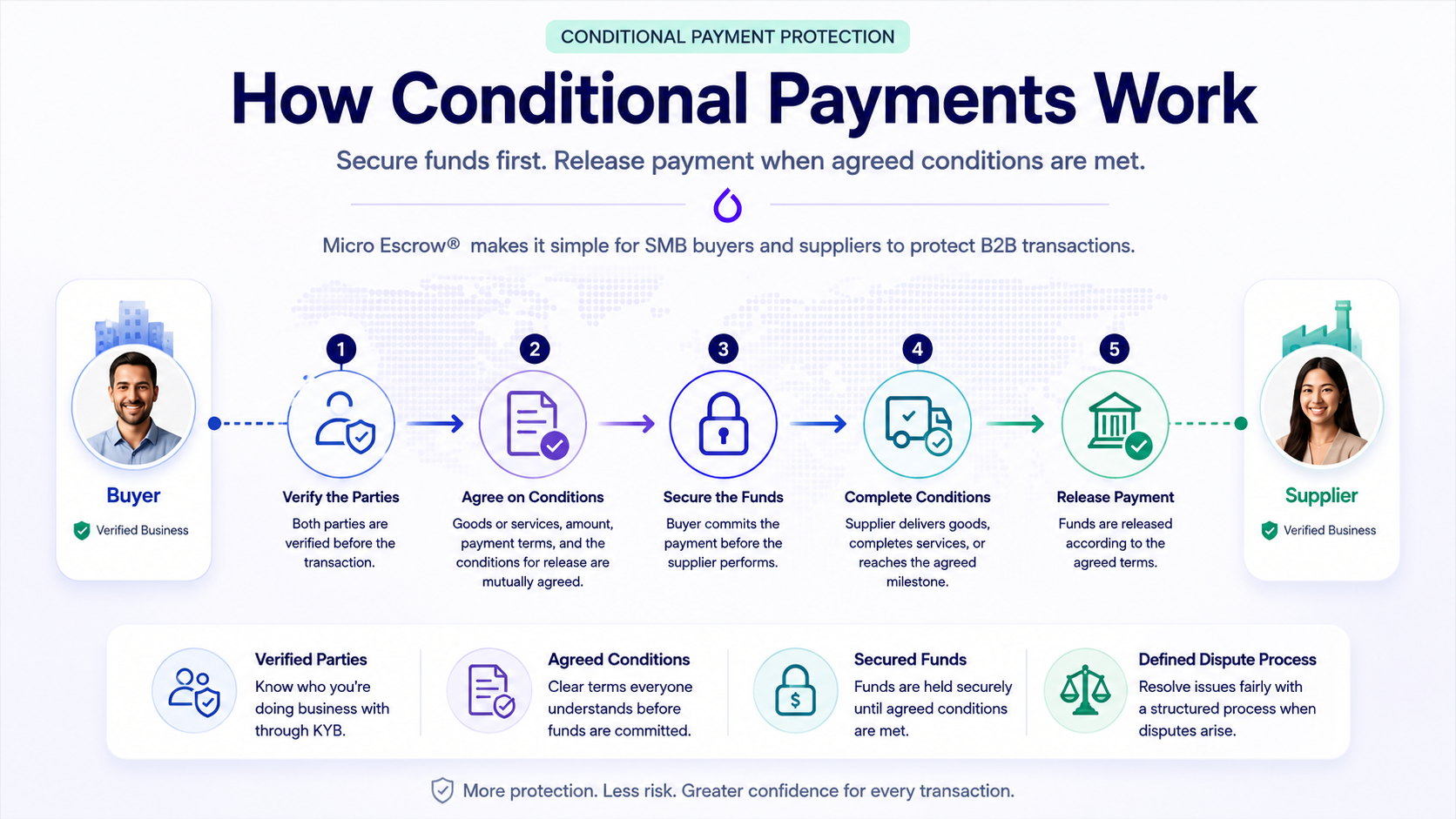
- A condition mutually agreed (or required by the platform) before the transaction starts, so both sides know what has to happen
- A release trigger tied to something observable, such as confirmed delivery or a closed inspection window
- A record of what was agreed and what occurred, so a disagreement has something factual at its center
Conditional Payments and Micro Escrow®: A Practical Way to Protect B2B Transactions sets out how agreed conditions work in a live transaction, and What “Secure B2B Payment Solutions” Really Mean for Marketplaces covers the release types.
The seller objection you will hear
Sellers rarely object to conditions. They object to uncertainty. Tell a seller their funds release on confirmed delivery, and they will usually accept it. Tell the same seller their payout is under review, and they start looking at your competitors.
Building the rule
A workable policy fits on one page and can be explained to buyers and sellers in two sentences.
- Determine if instant payout is ever appropriate given the types of buyers and sellers on the platform and the types of transactions taking place
- When instant payouts don't make sense, attach a release condition to each held state, not a duration
- Define a backstop for each held state, for the case where the seller never completes the conditions, and make it visible to both parties from the start
- Decide in advance who can release early, and log every manual release with a reason
- Publish the rule in onboarding rather than revealing it at the first held payout
- Review the signals against your actual dispute data each quarter and retire the ones that never fire
Treat the licensing question as gating, not procedural
Holding funds on behalf of a buyer and a seller can carry safeguarding, money transmission, or custody implications, and these are regulated differently across jurisdictions and platform models. Nothing in this article should be read as guidance on how they apply to a particular marketplace. Confirm the position with counsel before changing how funds are held.
The mistakes worth avoiding
Three failure patterns show up repeatedly. Applying one rule to all transactions, which either exposes the platform or drives away good supply or customers. Holding without conditions, which is a delay wearing a better name. And building the release logic manually, so that every hold becomes a support ticket and the operations cost grows with volume.
The last one is the quiet killer. A holding policy that requires a human to release every transaction works fine at low volume and stops working exactly when the marketplace starts succeeding. Manual release logic is the part that stops scaling first, which is the case for managed payments rather than building the hold yourself. Managed Payments for Modern Marketplaces covers that, and Marketplace Payments Compliance: 5 Hard-Won Lessons covers the compliance side.
The short version
Start by deciding whether instant payout is appropriate for the buyers, sellers, and transactions on your platform. Where the signals are low and the parties are known, instant payout may make sense, although the risk is lower, not gone. Where a transaction carries more risk, funds should be held against a condition mutually agreed or required by the platform rather than simply delaying payout for a set amount of time. Define a backstop for cases where the conditions are never completed, and make the rule visible to both parties from the start.
Know who would absorb the loss if a transaction failed: the buyer, the seller, or the platform. Then use transaction context, including seller history, order value, delivery structure, cross-border exposure, and buyer history, to determine when a hold is appropriate.
Micro Escrow® from LiquidTrust™ gives marketplaces conditional release as infrastructure rather than as manual operations: funds can be held against a transaction and released according to pre-defined conditions, with release logic and a record of what was agreed and what occurred.
About LiquidTrust™
LiquidTrust is a payments innovation company serving financial institutions, B2B platforms, and SMBs globally.