LiquidTrust is a payments innovation company serving financial institutions, B2B platforms, and SMBs globally.
Know Your Business, or KYB, helps SMBs confirm who they are trading with before money, goods, or resources are committed. When business identity, ownership, representatives, payment information, and transaction details are reviewed together, both sides have a stronger foundation for making informed decisions.
Technology is making it easier for SMBs to discover international buyers and suppliers.
But finding a business does not automatically confirm who owns it, whether the person communicating with you can represent it, or whether its payment information is legitimate.
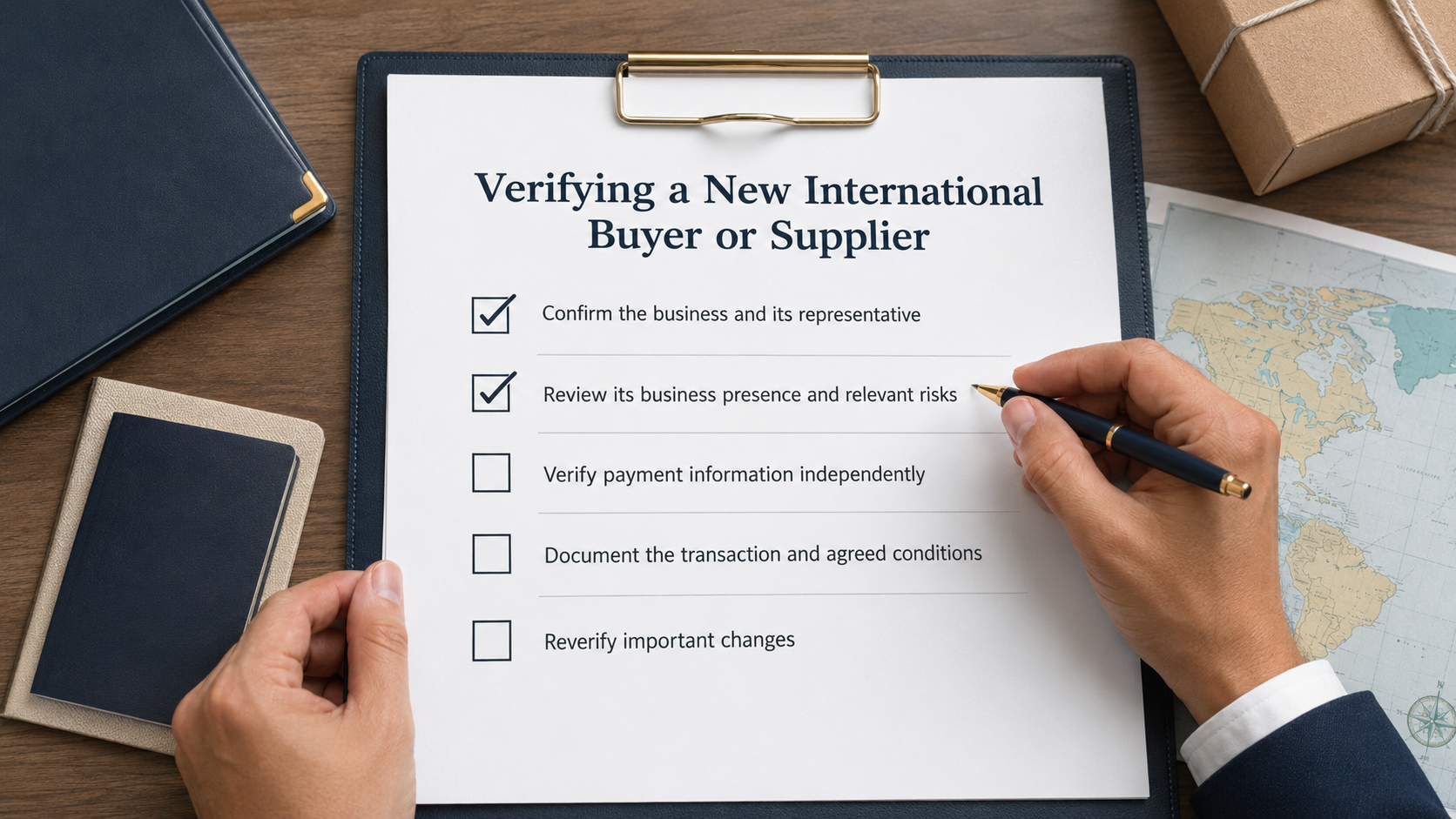
In our previous article, A Practical Guide to Verifying a New International Buyer or Supplier, we outlined five checks SMBs can complete before committing money, inventory, or resources.
Those checks reflect a broader verification framework known as Know Your Business, or KYB.
What Is KYB?
KYB is the process of confirming that a company is legitimate and identifying the people who own, control, or represent it.
It is the business-focused counterpart to Know Your Customer, or KYC. KYC generally verifies an individual, while KYB focuses on a company and the people connected to it.
A KYB review may include:
- Legal name and registration status
- Registered address
- Ownership and control
- Directors or authorized representatives
- Tax or company identification
- Required licenses or permits
- Relevant sanctions or risk indicators
The exact checks depend on the country, industry, organization, and transaction.
Depending on the business relationship, KYB may also include sanctions screening and anti-money laundering considerations.
Sanctions screening helps identify whether a business, its owners, or related parties appear on government sanctions lists that restrict or prohibit certain commercial activity.
Anti-money laundering measures are designed to help prevent businesses and financial institutions from unknowingly becoming involved in money laundering, fraud, terrorism financing, or other illegal financial activity.
Many financial institutions are required to perform these checks as part of their regulatory obligations. While SMBs may not have the same legal requirements, understanding these risks can help them make informed decisions before entering a new international business relationship.
For example, a payment could be delayed or rejected if a financial institution identifies potential sanctions or AML concerns during its own review. Performing reasonable verification upfront can help reduce surprises later in the transaction.
Financial institutions and certain other regulated organizations may be legally required to conduct formal customer due diligence. For example, FinCEN’s Customer Due Diligence Rule applies specific verification requirements to covered US financial institutions.
Not every SMB has the same legal obligations, but the principles behind KYB remain valuable when evaluating a new international business relationship.
Why KYB Can Become Time-Consuming
The purpose of KYB is simple.
The process can be much more complicated.
Information may be spread across government registries, ownership records, tax documents, licenses, contracts, sanctions lists, and banking details.
An SMB may need to:
- Find the correct registry for the company’s country.
- Confirm that the business is active.
- Compare its registration with its website, contract, and invoice.
- Identify its owners and authorized representatives.
- Review relevant licenses or risk indicators.
- Screen for sanctions or other financial crime risks when appropriate.
- Confirm that its payment information matches the verified business.
- Document what was checked and when.
Even legitimate businesses can have details that do not immediately match.
A company may trade under a different name from its legal name. Its operating address may differ from its registered address. An affiliated company may issue an invoice or receive payment.
There may be a reasonable explanation, but each difference must still be understood and confirmed.
These additional checks matter because incomplete verification can expose a business to fraud, payment issues, financial crime risks, or unexpected delays.
A payment may be held while a financial institution performs additional review. A transaction may need to be paused until discrepancies are resolved. In more serious situations, an SMB could unknowingly send funds to a fraudulent, sanctioned, or illegally controlled business.
The consequences may include financial loss, rejected or frozen payments, disrupted shipments, damaged business relationships, reputational harm, or the need for legal and compliance support.
Managing these checks across separate websites, documents, spreadsheets, and email conversations can quickly become difficult, especially for an SMB handling multiple international transactions.
Connecting KYB to the Transaction
KYB is most useful when the verified business information is connected to the specific transaction.
Before moving forward, an SMB should be able to confirm that:
- The contracting business has been identified.
- Its representative has appropriate authority.
- The payment beneficiary matches the verified relationship.
- The contract and invoice identify the correct parties.
- Important changes receive additional review.
This is especially important if ownership, payment beneficiaries, banking details, or authorized representatives change during the transaction.
While these changes may be legitimate, they can also increase fraud and financial crime risks if they are not independently verified.
This matters because verification can become outdated.
A new contact may enter the conversation. Banking details may change. The buyer may request a different shipping destination. The value of the transaction may increase.
These changes may be legitimate, but they should be confirmed before money or goods move.
A connected verification process keeps the business identity, representatives, payment details, transaction terms, and later changes together. This makes the information easier to review and reduces dependence on scattered records.
KYB Creates a Foundation for Trust
KYB cannot guarantee that every transaction will succeed.
A verified supplier may still experience a delay. A legitimate buyer may still pay late.
It also cannot eliminate every fraud or compliance risk.
However, a thoughtful KYB process helps reduce the likelihood of doing business with fraudulent companies, sanctioned entities, or organizations involved in illegal financial activity. It also helps businesses identify inconsistencies before money changes hands.
At its core, KYB helps SMBs answer several important questions:
- Is this business legitimate?
- Is the person I am communicating with authorized to represent it?
- Do the payment details match the verified business?
- Are there warning signs that should prompt additional review before proceeding?
The transaction still needs clear payment terms, delivery requirements, documentation, and a process for managing changes.
Verification creates a stronger foundation when it is connected to who is involved, who should receive payment, and what each side has agreed to do.
Looking Ahead
KYB helps businesses understand who they are working with, identify potential risks early, and make more informed decisions before entering an international transaction.
The next question is how the transaction should be structured.
In our next article, we will explore common international payment terms and how SMBs can choose an approach that reflects the relationship, transaction value, and risks carried by each side.
Finding a buyer or supplier creates the opportunity.
KYB helps build confidence in who is involved.
Clear payment terms help both sides decide how to move forward.
For more guidance on reducing transaction risk, read What Is Your Recourse for Non-Payment or Non-Delivery?.
Glossary
Know Your Business (KYB): The process of verifying a company’s identity, registration, ownership, control, and authorized representatives.
Know Your Customer (KYC): The process of verifying the identity of an individual.
Sanctions screening: The process of checking whether a business, owner, representative, or related party appears on an applicable government sanctions list.
Anti-money laundering (AML): Policies and controls designed to detect and prevent money laundering and other illegal financial activity.
Learn more about how LiquidTrust helps SMBs protect international transactions.