LiquidTrust™ is a payments innovation company serving financial institutions, B2B platforms, and SMBs globally.
In our previous article, Choosing Payment Terms for Your First International Transaction, we explored how buyers and suppliers can decide when payment should move and how risk should be shared.
But agreeing on payment terms does not necessarily protect either side if the transaction does not go as planned.
For a first cross-border transaction between two parties, this can be difficult. The buyer may not want to pay before receiving the agreed goods or services, while the supplier may not want to begin work, provide services, produce goods, or ship without confidence that payment is available.
For decades, letters of credit have helped businesses manage this problem.
But they are not practical for every transaction.
Where Letters of Credit Make Sense
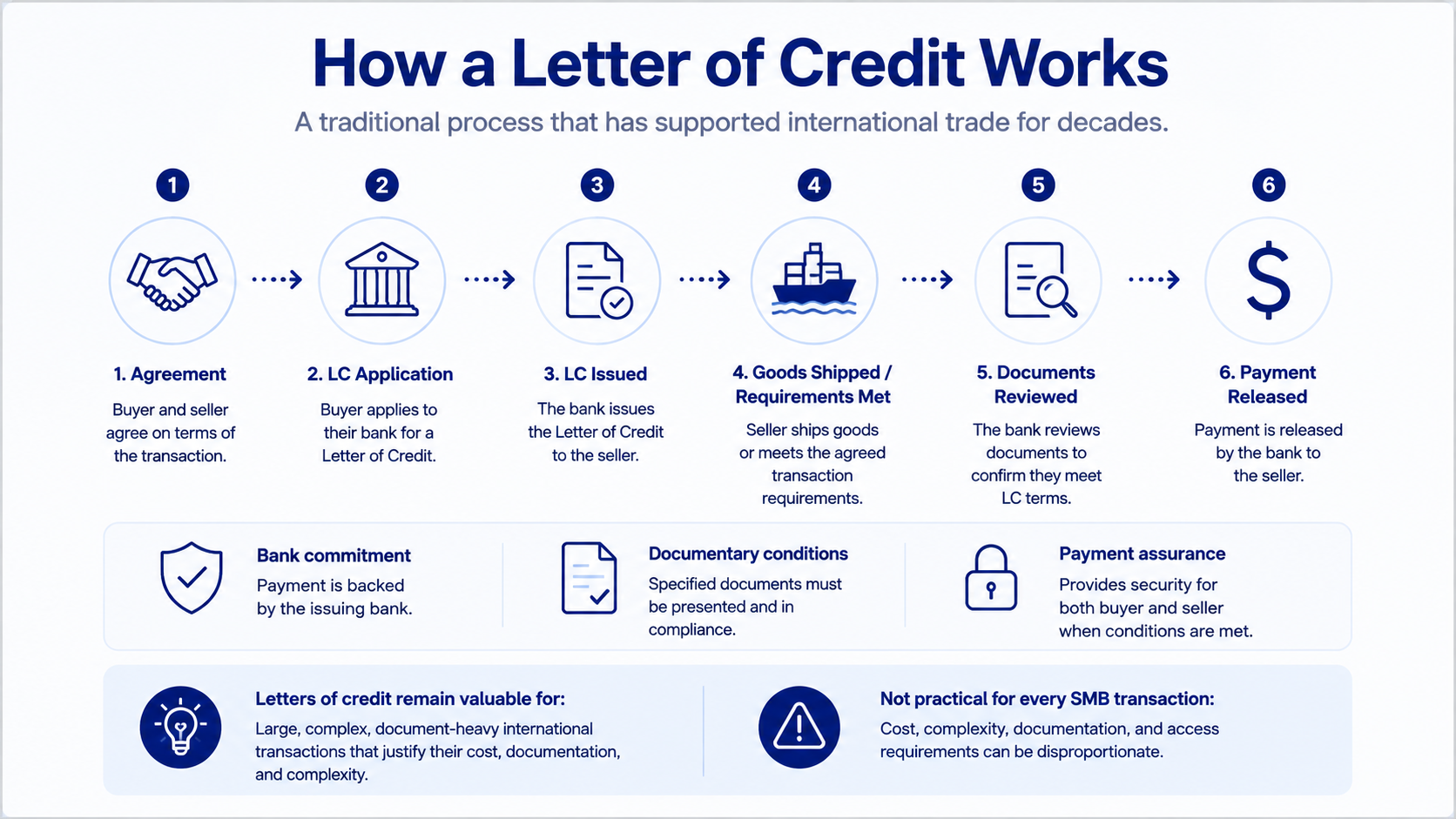
A letter of credit is a bank commitment to pay a supplier when specified terms and documentary requirements are satisfied.
Letters of credit can make sense when:
- The transaction value is high
- The parties (or their suppliers) need bank-backed payment assurance
- The transaction involves established shipping and trade documents
- The businesses can manage detailed documentary requirements
- The value of the transaction justifies the fees and administrative process
For large and complex international transactions, that structure can provide valuable protection.
The challenge is that many SMB transactions look very different.
Why Letters of Credit Can Be Difficult for SMBs
SMBs want many of the same protections as larger companies. Buyers want confidence that suppliers will perform, while suppliers want confidence that they will be paid.
But letters of credit can involve bank approval, fees, strict documentation, manual review, and delays when documents do not precisely satisfy the stated conditions. Access can also depend on the banks involved. Not every bank issues letters of credit, and a supplier’s bank may not accept an LC issued by another bank. Even when an LC is available, the cost and administrative effort may not make sense for a smaller transaction.
They can also be less natural for transactions involving:
- Professional or digital services
- Custom goods
- Project-based work
- Multiple milestones
- Inspection or acceptance periods
For many SMBs, the issue is not that letters of credit do not work. It is that the cost, complexity, or access requirements may be disproportionate to the transaction.
The Protection Gap for SMBs
Without a letter of credit, businesses often fall back on simpler payment structures.
Full advance payment protects the supplier but exposes the buyer.
Open-account terms protect the buyer but expose the supplier.
Partial or milestone payments divide the risk but still require both sides to trust that the other will perform.
This creates a gap between ordinary payment methods and traditional trade finance.
SMBs need ways to protect meaningful transactions without turning every new business relationship into a complex banking process.
A More Flexible Approach
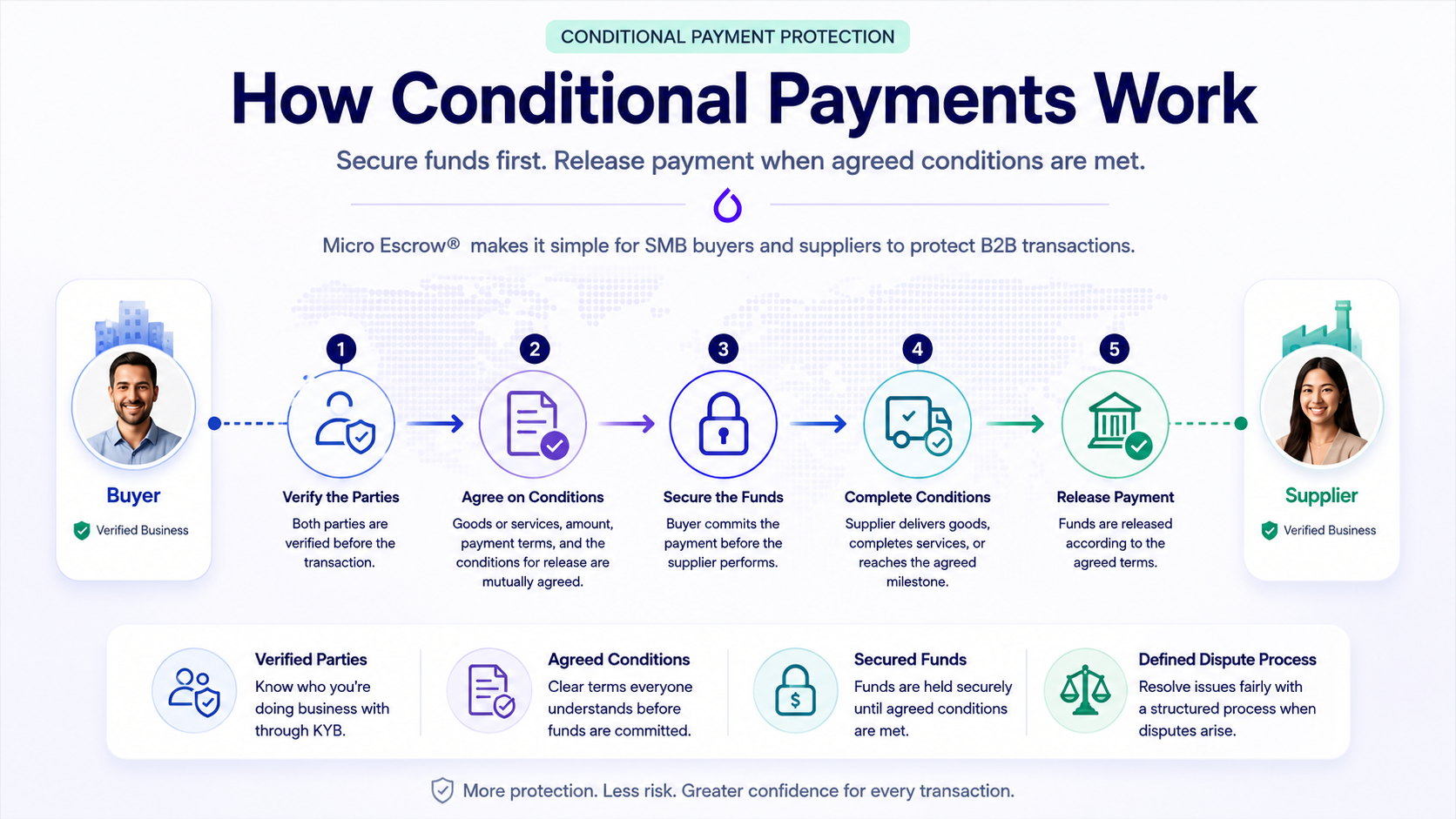
One option is conditional payment.
Instead of sending funds directly to the supplier before performance, funds can be secured and released when agreed conditions are met.
Those conditions could include:
- Shipment of goods
- Delivery of goods
- Completion of services
- Completion of a milestone
- Document uploads
- Inspection of goods/services
- Acceptance of goods/services
- Anything the two parties agree
This gives the buyer protection against premature payment while giving the supplier confidence that funds have been committed. Both sides are protected, and it allows the payment structure to reflect the transaction itself.
Looking Ahead
Letters of credit remain valuable for transactions that justify their structure and complexity.
But many SMBs need something simpler and more flexible.
In our next article, we will explore how conditional holds and Micro Escrow® can connect business verification, secured funds, agreed conditions, and payment release through one transaction process.
Payment terms establish the agreement. Transaction protection helps both sides carry it out.
Key Takeaways
- Letters of credit can provide strong protection for large, complex, document-heavy international transactions.
- Their cost, documentation, and access requirements can make them impractical for many SMB transactions.
- Conditional payments can provide another option by connecting payment release to delivery of goods, completion of services, milestones, inspection, or acceptance.